Menu

Why You Should Reset Your Planner Every Sunday (Even If Last Week Fell Apart)
By Wednesday, most planners stop telling the truth. If you’ve ever wondered why you should reset your planner every Sunday, it starts right there, in the middle of the week, when the page you wrote on Monday no longer looks anything like your actual life.
You know the page I mean.
Monday was beautiful. Color-coded, even. You had your top priorities, your appointments, your workout, the client call, the grocery list, and that one project you have been meaning to start for three weeks.
Then Tuesday happened.
A child woke up sick. A client needed something “quick.” The dishwasher made a noise it has never made before. Someone needed a ride, someone else needed a snack, and somewhere in the middle of it all, you forgot to even open your planner.
By Wednesday, the page is half crossed out, half ignored, and completely overwhelming to look at. So you stop looking at it.
I’ve been there more times than I can count. And for a long time, I thought it meant I just “needed a better planner”
It turns out I wasn’t failing at planning. I was skipping the reset.
Why Your Planner Stops Working by Wednesday
A planner is only as useful as it is current.
The moment your plan stops matching your real life, it quietly shifts from being a tool to being a reminder of everything you didn’t get to. That’s when planners start collecting dust (or, if you use Notion, collecting unchecked boxes).
Here’s what usually happens:
- Unfinished tasks roll forward, day after day, until the list is impossibly long.
- New things get added in the margins, on sticky notes, or nowhere at all.
- Appointments and commitments live in three different places.
- You lose track of what actually matters this week, because everything looks equally urgent.
None of that means you did something wrong. Life moves faster than paper (or pixels). A plan made on Monday was always going to need a little tending by the following Sunday.
That’s what a reset is. Not a do-over. A little tending.
What It Really Means to Reset Your Planner Every Sunday
When I say “reset your planner,” I don’t mean rewriting your entire life or starting a brand-new system.
I mean taking a small window of time at the end of the week to bring your plan back into alignment with reality. You look at what happened, decide what comes with you, let go of what doesn’t, and set up the week ahead so it feels clear instead of crowded.
It’s less “productivity hack” and more “clearing the kitchen counter before you start cooking.” You can technically cook on a cluttered counter. It’s just harder, slower, and a lot more stressful.
I’ve already walked through my full Sunday reset routine step by step. This post is about the why, because once you understand what the reset is actually doing for you, it becomes much easier to keep coming back to it.
5 Things a Sunday Planner Reset Does for You
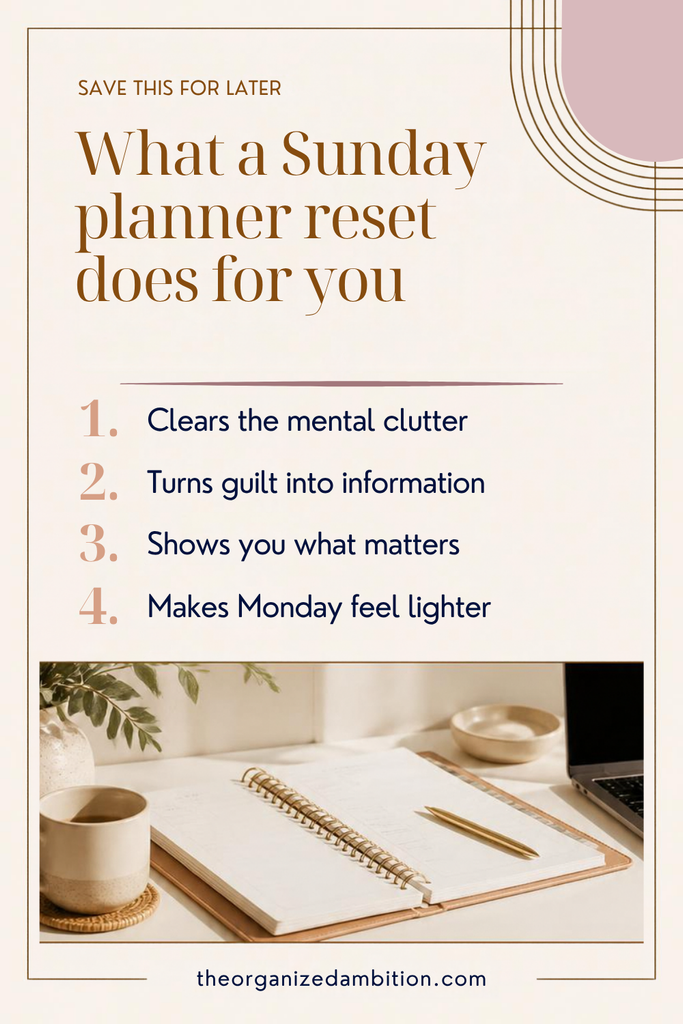
1. It clears the mental clutter
All week long, you’re collecting little mental notes: the permission slip, the email you need to answer, the idea you had in the car. A reset gives all of it a place to land, so your brain can stop holding it.
2. It turns guilt into information
That list of things you didn’t finish? It’s not a report card. It’s data. A reset helps you ask, “Why didn’t this happen?” Was the week too full? Was the task too big? Did it actually matter? Now you can plan with honesty instead of hope.
3. It shows you what actually matters this week
When everything is on one long list, everything feels urgent. A reset lets you choose your top three priorities on purpose, so you know where to put your energy when (not if) the week gets interrupted.
4. It stops you from carrying last week into this one
Without a reset, unfinished tasks just keep sliding forward, and so does the heaviness that comes with them. A reset is permission to decide: do it, schedule it, delegate it, or let it go.
5. It makes Monday feel lighter
This is my favorite part. When you wake up Monday already knowing what matters, what’s on the calendar, and what can wait, the whole week starts from a place of calm instead of catch-up.
Why Sunday Is the Right Day
You can reset your planner any day of the week, and if Sunday doesn’t work for your family, pick the day that does.
But there’s something about Sunday.
It sits right at the edge of the week, when things are usually a little quieter. The busy of the last week is behind you, the busy of the next one hasn’t started yet, and there’s a natural pause that makes reflection feel easier. For a lot of us, it’s also a day that’s already set apart for rest, and a gentle reset fits right into that rhythm. It isn’t more work. It’s making room for peace.
And honestly, it’s much easier to face Monday when Sunday already said, “We’ve got this.”
You Don’t Need a Perfect Week to Reset
This might be the most important part.
The weeks when your planner fell apart are the weeks you need the reset most. Not the tidy weeks. The messy ones.
You don’t need to have checked off every box to earn a fresh start. You don’t need to catch up first. You just need to sit down, look honestly at where things are, and begin again.
That’s the whole point. A planner isn’t a record of how well you performed. It’s a tool to help you live the life you actually have, with a little more clarity and a lot more grace.
As I shared in why you still feel behind, the goal isn’t to do more. It’s to carry less.
How to Start Resetting Your Planner This Sunday
Start small. Twenty minutes is plenty.
- Brain dump everything that’s on your mind.
- Review last week: what got done, what didn’t, and why.
- Choose your top 3 priorities for the week ahead.
- Look at your week at a glance: appointments, commitments, and any busy days you can see coming.
- Let something go. Seriously. Pick one thing that doesn’t need to come with you.
Then close your planner and go enjoy the rest of your Sunday.
Ready to Reset Your Planner This Sunday?
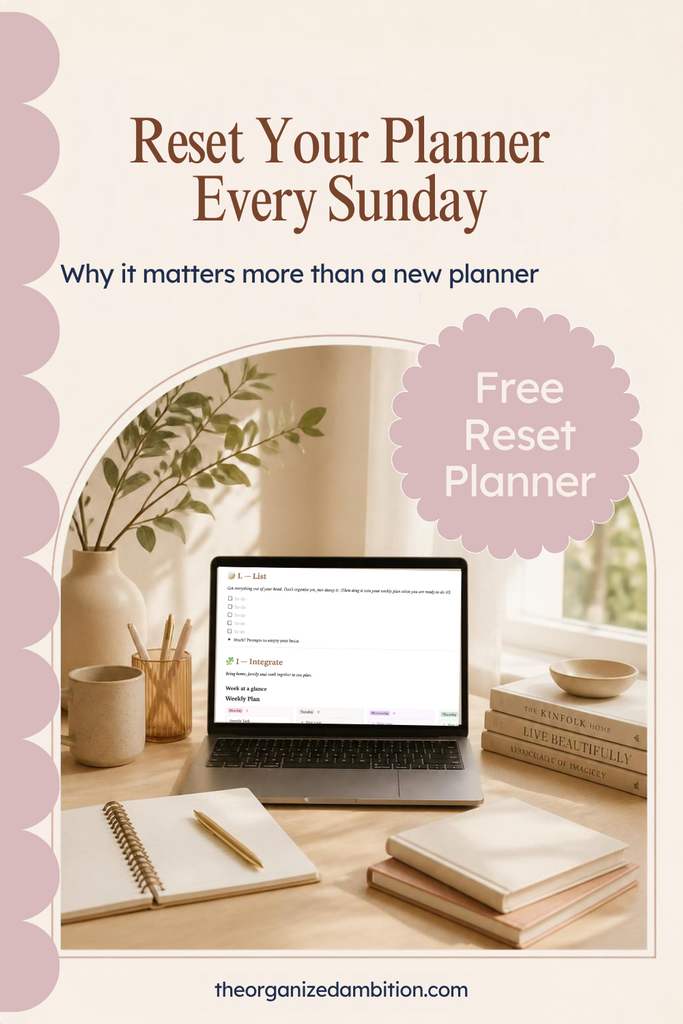
If you’d like a simple place to start, my free 20-Minute Weekly Reset Planner walks you through a brain dump, your top three priorities and your week at a glance, so you can clear the clutter and step into Monday feeling ready instead of behind.